Showing posts with label memorial. Show all posts

Wednesday, November 3, 2010

Feast of St Malachy

Today, 3 November is the feast day of St Malachy.

Here's a snippet from the very first entry on this blog:

Malachy born in Armagh in 1094 and was bapised Maolmhaodhog Ua Morgair, usually Anglicised as Malachy O'More. He was successively vicar-general to St Cellach, abbot of Bangor, then bishop of Connor before becoming archbishop of Armagh in1094. His primary achievement as a bishop may well have been his success at replacing the Celtic liturgy with the Roman.

In 1138, Malachy resigned as archbishop of Armagh to go on pilgrimage to Rome, meeting and staying with St Bernard at Clairveaux for a time.

Malachy attempted a second Rome pilgrimage in 1148 but only made it as far as Clairveaux where he died in the arms of St Bernard. He was formally canonised by Pope Clement III in 1190.

No doubt most people know of Malachy because of his "prophecies of the popes". These prophecies are a list of 112 short Latin phrases supposedly describing 112 popes, beginning with Celestine II (1143) and ending with Peter II, who is of course, yet to be elected. After the election of Peter II or Petrus Romanus will come the destruction of Rome and the final judgement.
Malachy died in the arms of St Bernard of Clairveaux on 2 November 1148. His feast day is celebrated on 3 November so that it doesn't clash with All Souls Day.


Wednesday, October 6, 2010

St Bruno and happy birthday!

6 October is the memorial of St Bruno, priest and founder of the Carthusians. It is also the birthday of this blog which has been online for one year today. I suppose it's therefore appropriate to place the blog under his co-patronage henceforth!

According to the Divine Office entry, St Bruno was:

Born at Cologne about the year 1035. After being educated at Paris and ordained priest, he taught theology; but wanting to lead the life of a solitary he founded the monastery of La Grande Chartreuse. He was called to Rome by Pope Urban II to be his adviser and helper in the needs of the Church. He died at Squillace in Calabria in the year 1101.

Monday, September 27, 2010

Saint Vincent de Paul


27 September is the memorial day for the well known saint, St Vincent de Paul. The Divine Office note about him says:
Born in Gascony in France in the year 1581. He completed his studies and was ordained priest in Paris. He founded the Congregation of the Mission (Vincentians) for the purpose of the spiritual formation of the clergy and the relief of the poor, and with the help of Saint Louise de Marillac he founded also the Congregation of the Sisters of Charity. He died at Paris in the year 1660.
Catholic Encyclopedia entry

Monday, September 13, 2010

Golden Mouth


Today is the feast day of St John Chrysostom, Bishop and Doctor of the Church. The introductory note in the Divine Office says:
Born at Antioch about the year 439. After a brilliant course of studies he began to lead a life of austerity. He was ordained priest and laboured in preaching, with great fruit. In 397 he became Bishop of Constantinople and showed himself a true pastor, striving to reform the morals of both clergy and people. He incurred the hatred of the imperial court and his work was undermined because of jealousy, and twice he was sent into exile. Overcome by exhaustion he died at Comana in Pontus on 14 September 407. Because of his sermons and writings to explain the faith and to encourage the practice of Christian life he was called John of the Golden Mouth.
Under the old calender, his feast day was 27 January.

Friday, August 27, 2010

St Monica

27 August is the feast day of St Monica, mother of St Augustine. From Universalis:

She was born at Thagaste in Africa of a Christian family. She was married young, to Patricius, and among her children was Augustine. He had a brilliant intellect and uncertain morals and his wayward spiritual career saw him at one time a Manichee and then a Neoplatonist. With many tears she prayed unceasingly to God for his conversion and her prayers were answered shortly before she died. She had a deep faith and outstanding virtue and is a wonderful example of a Christian mother.

Monday, July 26, 2010

Saint Joachim and Saint Anne

Today is the memorial of the parents of our Lady, Saints Joachim and Anne. As the breviary note about them says:

An old tradition going back to the second century gives these names to the parents of the Blessed Virgin Mary. The veneration of Saint Anne dates from the sixth century in the East and spread throughout the West in the tenth century; that of Saint Joachim is more recent.
Tradition has it that Saints Joachim and Anne were childless until Saint Joachim went into the desert for fasting and penance for forty days. Angels then appeared to both saints promising them a child. Joachim returned to Jerusalem meeting Anne at the city gate.

Thursday, July 15, 2010

The Seraphic Doctor and St Swithun

Today is the memorial of the great Franciscan, Bishop and Doctor of the Church, St Bonaventure. From Universalis we see:

He was born at Bagnoregio in Etruria in about 1218. He became a Franciscan in 1243 and studied philosophy and theology at the University of Paris. He became a famous teacher and philosopher, part of the extraordinary intellectual flowering of the 13th century. He was a friend and colleague of St Thomas Aquinas.
  At this time the friars were still a new and revolutionary force in the Church, and their radical embracing of poverty and rejection of institutional structures raised suspicion and opposition from many quarters. Bonaventure defended the Franciscan Order and, after he was elected general of the order in 1255, he ruled it with wisdom and prudence. He is regarded as the second founder of the Order.
  He declined the archbishopric of York in 1265 but was made cardinal bishop of Albano in 1273, dying a year later in 1274 at the Council of Lyons, at which the Greek and Latin churches were (briefly) reconciled.
  Bonaventure wrote extensively on philosophy and theology, making a permanent mark on intellectual history; but he always insisted that the simple and uneducated could have a clearer knowledge of God than the wise.
  He was declared a Doctor of the Church in 1588 by Pope Sixtus V.

In our diocese it is also the memorial of St Swithun, the Anglo-Saxon Bishop of Winchester who died in 862. Probably the most well known thing about St Swithun is the folk lore that says whatever the weather may be on St Swithun's Day is the what the weather will be for the next forty days.
St Swithun's day if thou dost rain
For forty days it will remain
St Swithun's day if thou be fair
For forty days 'twill rain no more
As it's pretty grim today, I think I'll take the view it's all an old wifes tale!

Tuesday, July 6, 2010

St Maria Goretti

St Maria Goretti was a 12 year old Virgin and Martyr. Today is her memorial.

The breviary note about her says, simply:
Born at Ancona in Italy of a poor family in the year 1890. She spent her childhood near Nettuno in poverty, helping her mother in the domestic chores. She was a religious girl and much given to prayer. In the year 1902, while defending her chastity against a man attempting to violate her, she preferred to die rather than give way, and was repeatedly stabbed with a knife.
She was canonised by Pope Pius XII in 1950.

More on Wikipedia here.

Wednesday, June 30, 2010

The First Martyrs of the See of Rome

30 June is the memorial of The First Martyrs of the See of Rome. We do not know the names of those martyrs, nor do we know their number. The breviary entry for today says about them:
In the first persecution against the Church, that of the Emperor Nero, after the City of Rome had been burnt in the year 64, many of the faithful suffered death after terrible tortures. Testimony to their deaths is found in the writings of the pagan Tacitus (Annales, 15, 44) as well as in the letter to the Corinthians of Pope Saint Clement (cap. 5-6)

Monday, June 21, 2010

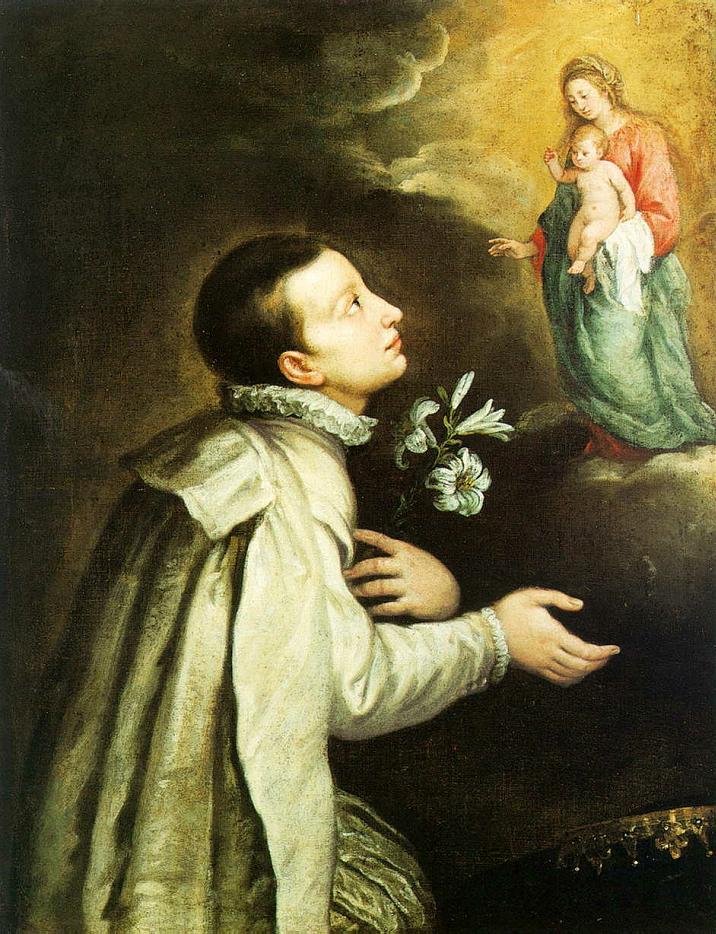
St Aloysius Gonzaga

21 June is the memorial of St Aloysius Gonzaga. The breviary note about him says:

Born in the year 1568 near Mantua in Lombardy, of the noble family of Castiglione. He was brought up piously by his mother and had a vocation to the religious life. He resigned his birthright to his brother and at Rome entered the Society of Jesus. While working among the sick in a hospital he was stricken by the plague and died in the year 1591.

Wednesday, June 2, 2010

Saints Marcellinus and Peter

Saints Marcellinus and Peter the Exorcist were martyred in 304. Today is their memorial and we read in the breviary:

The account of the death of these two martyrs, who died in the persecution of Diocletian, comes from Pope Damasus who in turn obtained it from the executioner. The were beheaded in a wood and then buried in the cemetery called The Two Laurels on the Via Labicana. When peace came to the Church a basilica was erected over their tomb.
More info here (Wiki entry) and here (Catholic Encyclopedia).

Tuesday, June 1, 2010

St Justin, Martyr

1 June is the memorial of St Justin, Martyr, a significant early apologist.

In the anonymous Acts of the martyrdom of Saint Justin and his companion saints, which was written shortly after Justin's martyrdom in the year 165 we read:

The saints were seized and brought before the prefect of Rome, whose name was Rusticus. As they stood before the judgement seat, Rusticus the prefect said to Justin: "Above all, have faith in the gods and obey the emperors." Justin said: "We cannot be accused or condemned for obeying the commands of our Saviour, Jesus Christ."

Rusticus said: "What system of teaching do you profess?" Justin said: "I have tried to learn about every system, but I have accepted the true doctrines of the Christians, though these are not approved by those who are held fast by error."

The prefect Rusticus said: "Are those doctrines approved by you, wretch that you are?" Justin said: "Yes, for I follow them with their correct teaching."

The prefect Rusticus said: "What sort of teaching is that?" Justin said: "Worship the God of the Christians. We hold him to be from the beginning the one creator and maker of the whole creation, of things seen and things unseen. We worship also the Lord Jesus Christ, the Son of God. He was foretold by the prophets as the future herald of salvation for the human race and the teacher of distinguished disciples. For myself, since I am a human being, I consider that what I say is insignificant in comparison with his infinite godhead. I acknowledge the existence of a prophetic power, for the one I have just spoken of as the Son of God was the subject of prophecy. I know that the prophets were inspired from above when they spoke of his coming among men."

Rusticus said: "You are a Christian, then?" Justin said: "Yes, I am a Christian."

The prefect said to Justin: "You are called a learned man and think that you know what is true teaching. Listen: if you were scourged and beheaded, are you convinced that you would go up to heaven?" Justin said: "I hope that I shall enter God’s house if I suffer that way. For I know that God’s favour is stored up until the end of the whole world for all who have lived good lives."

The prefect Rusticus said: "Do you have an idea that you will go up to heaven to receive some suitable rewards?" Justin said: "It is not an idea that I have; it is something I know well and hold to be most certain."

The prefect Rusticus said: "Now let us come to the point at issue, which is necessary and urgent. Gather round then and with one accord offer sacrifice to the gods." Justin said: "No one who is right thinking stoops from true worship to false worship."

The prefect Rusticus said: "If you do not do as you are commanded you will be tortured without mercy." Justin said: "We hope to suffer torment for the sake of our Lord Jesus Christ, and so be saved. For this will bring us salvation and confidence as we stand before the more terrible and universal judgement - seat of our Lord and Saviour."

In the same way the other martyrs also said: "Do what you will. We are Christians; we do not offer sacrifice to idols."

The prefect Rusticus pronounced sentence, saying: "Let those who have refused to sacrifice to the gods and to obey the command of the emperor be scourged and led away to suffer capital punishment according to the ruling of the laws." Glorifying God, the holy martyrs went out to the accustomed place. They were beheaded, and so fulfilled their witness of martyrdom in confessing their faith in their Saviour.

Wednesday, May 26, 2010

St Philip Neri

26 May is the memorial of St Philip Neri.

The breviary says about him:
Born in Florence in the year 1515. He came to Rome and began to devote himself to work among the young men, while at the same time he led a Christian life and formed a brotherhood to look after the sick poor. In 1551 he became a priest and formed the Oratory in which he held services consisting of spiritual readings and hymns, as well as performing charitable works. He was outstanding for love of his neighbour, and evangelical simplicity and joyfulness in the service of God. He died in the year 1595.
More at his Catholic Encyclopedia entry here and his Wiki here.

Tuesday, March 23, 2010

St Turibius of Mongrovejo

23 March is the feast day of St Turibius, Bishop of Lima. The breviary says:

Born in Spain about the year 1538. He studied law in Salamanca and in 1580 was chosen to be Bishop of Lima and went to America. He was on fire with apostolic zeal and called together synods and councils for the purpose of reforming religion in the whole country. He strenuously defended the rights of the Church and looked after the flock committed to his care by going among them on visitation, as well as spending much time and labour for the good of the native Indian population. He died in 1606.

St Turibius was beatified in 1679 by Pope Blessed Innocent XI.

Thursday, March 18, 2010

St Cyril of Jerusalem

Today is the memorial of St Cyril of Jerusalem, Bishop and Doctor of the Church.


The breviary note says about him:
Born of Christian parents in the year 315. He succeeded Maximus as Bishop of Jerusalem in 348. He was involved in the Arian controversy and more than once was sentenced to exile. His Catecheses in which he explained the true doctrine of the faith and Sacred Scripture as well as the tradition of the Church for the sake of the people show his pastoral zeal. He died in the year 386.

His Catholic Encyclopedia entry is here.

Monday, March 1, 2010

St David

St David is not a saint who appears in the General Calendar. He is, however, the patron saint of Wales and so today, 1 March, is a feast in England and a solemnity in Wales.

Very little is known for certain about Saint David. He was probably born in Cardigan circa 520. He was a bishop and primate of Wales and died around 588. He was renowned as a preacher and founded monasteries and churches all over Wales.

Unlike  the patron saints of the other nations making up the British Isles (Andrew, Patrick and George) David was actually born in the country of which he is patron.

He was canonized by Pope Callistus II in 1123.

Tuesday, February 23, 2010

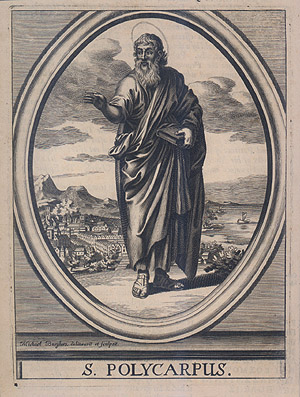
St Polycarp, Bishop and Martyr


23 February is the memorial of St Polycarp, Bishop of Smyrna and Martyr.

The Breviary says about him: Polycarp was a disciple of the apostles and bishop of Smyrna, as well as a friend of St Ignatius of Antioch. He went to Rome to confer with Pope Anicetus about the celebration of Easter. He suffered martyrdom about the year 155 by being burnt to death in the city stadium.

Wednesday, February 10, 2010

St Scholastica

10 February is the memorial of St Scholastica. The breviary says about her:

The sister of St Benedict,  born at Norcia in Umbria about the year 480. Together with her brother she consecrated herself to God, and she followed Benedict to Monte Casino, where she died about the year 547.

Saturday, February 6, 2010

Patronal feast day

Today is one of the two patronal feast days of our parish church, Our Lady of the Annunciation and the Martyrs of Japan.

St Paul Miki and his 25 companions were martyred, by crucifixion, in Nagasaki on 5 February 1597.  Of the 26, six were European Franciscan missionaries, three (including St Paul Miki) were Japanese Jesuits and the remaining 17 were Japanese laymen. Three were children, or at least young boys.

The Japanese Martyrs were added to the General Calendar in 1969.

Tuesday, January 26, 2010

Saint Timothy and Saint Titus

Saints Timothy and Titus where early bishops and today is their memorial.

The breviary says: Timothy and Titus were disciples and helpers of the apostle Paul, the former being placed in charge of the Church at Epheus, the latter the Church at Crete. Saint Paul wrote his pastoral epistles to them, containing much useful advice for the instruction of the clergy and people.