Showing posts with label saint. Show all posts

Thursday, November 3, 2011

St Malachy

Today is the feast day of the saint after whom this blog is named - Malachy. So, from the archives of this blog:

St Malachy, who was he?

Malachy died on 2 November 1148 but his feast day is kept on 3 November to avoid a clash with All Souls Day.

source: Patricia Drury at http://en.wikipedia.org/wiki/St_Malachy
As an aside, it's also the feast day of St Martin de Porres

Saturday, July 16, 2011

St Helier

16 July is the feast day of St Helier, patron saint of the "capital" of Jersey and of one of the twelve civil parishes on the island.

Helier was a 6th century hermit who came to the island of wandering from what is now Belgium, through Normandy and eventually to the island. On arrival in Jersey Helier settled on a rocky outcrop just offshore that is now called the Hermitage Rock. From this viewpoint he could spot pirates and other ne'er do goods sailing toward the island and warn the people onshore.

Legend has it he was beheaded by pirates on 16 July 555.

If it wasn't pouring down I'd take a picture of l'Hermitage to put up so here is one from Wikipedia instead:

Tuesday, March 1, 2011

Dewi sant hapus I chi

Happy St David's day.

The Divine Office note for St David says:
Born probably in Cardigan about the year 520, he received his early training from St Illtyd. He attraced many postulants to the monastries he founded, all of which were remarkable for the austerity of their rule of life. Consecrated bishop, according to his biographer, in Jerusalem, he was recognised as primate of Wales and established his see at Mynyw (Menevia), at the monastry of which he was abbott and where he died about the year 588. He is the principal patron of Wales

Friday, January 14, 2011

Blessed John Paul II

The Catholic Herald have the breaking news that John Paul II is to be beatified on 1 May this year!

Here is the note released by the Vatican Information Service this morning:


BENEDICT XVI WILL BEATIFY JOHN PAUL II ON 1 MAY

VATICAN CITY, 14 JAN 2011 (VIS) - On 1 May, the second Sunday of Easter and Divine Mercy Sunday, Benedict XVI will preside at the rite of beatification for John Paul II in the Vatican.

  According to a note released by the Congregation for the Causes of Saints, "today 24 January, Benedict XVI, during an audience granted to Cardinal Angelo Amato S.D.B., prefect of the Congregation for the Causes of Saints, authorised the dicastery to promulgate the decree of the miracle attributed to the intercession of Venerable Servant of God John Paul II (Karol Wojtyla). This concludes the process which precedes the rite of beatification.

  "It is well known that, by pontifical dispensation, his cause began before the end of the five-year period which the current norms stipulate must pass following the death of a Servant of God. This provision was solicited by the great fame of sanctity which Pope John Paul II enjoyed during his life, in his death and after his death. In all other ways, the normal canonical dispositions concerning causes of beatification and canonisation were observed in full.

  "Between June 2005 and April 2007 the principal diocesan investigation was held in Rome, accompanied by secondary investigations in various other dioceses, on his life, virtues, fame of sanctity and miracles. The juridical validity of these canonical processes was recognised by the Congregation for the Causes of Saints with a decree of 4 May 2007. In June 2009, having examined the relative 'Positio', nine of the dicastery's theological consultors expressed their positive judgement concerning the heroic nature of the virtues of the Servant of God. The following November, in keeping with the usual procedure, the 'Positio' was submitted for the judgement of the cardinals and bishops of the Congregation for the Causes of Saints, who gave their approval.

  "On 19 December 2009, Benedict XVI authorised the promulgation of the decree on John Paul II's heroic virtues.

  "With a view to the beatification of the Venerable Servant of God, the postulator of the cause invited the Congregation for the Causes of Saints to examine the recovery from Parkinson's disease of Sr. Marie Simon Pierre Normand, a religious of the 'Institut des Petites Soeurs des Maternites Catholiques'.

  "As is customary, the voluminous acts of the regularly-instituted canonical investigation, along with detailed reports from medical and legal experts, were submitted for scientific examination by the medical consultors of the Congregation for the Causes of Saints on 21 October 2010. The experts of the congregation, having studied the depositions and the entire documentation with their customary scrupulousness, expressed their agreement concerning the scientifically inexplicable nature of the healing. On 14 December the theological consultors, having examined the conclusions reached by the medical experts, undertook a theological evaluation of the case and unanimously recognised the unicity, antecedence and choral nature of the invocation made to Servant of God John Paul II, whose intercession was effective in this prodigious healing.

  "Finally, on 11 January 2011 the ordinary session of the cardinals and bishops of the Congregation for the Causes of Saints took place. They expressed their unanimous approval, believing the recovery of Sr. Marie Simon Pierre to be miraculous, having been achieved by God in a scientifically inexplicable manner following the intercession of the Supreme Pontiff John Paul II, trustingly invoked both by Sr. Simon herself and by many other faithful".
CCS/                                                                                                VIS 20110114 (570)
Blessed John Paul II has a rather nice ring to it!

Thursday, October 28, 2010

Saint Simon and Saint Jude

28 October is the deast day of two of the apostles, Saints Simon and Jude.


The introductory note for todays Divine Office entry reads:
The name of Simon is placed eleventh in the list of apostles and nothing is known of him except that he was born at Cana and was known as the Zealot.
Jude, also known as Thaddeus, was the apostle who, at the Last Supper, asked the Lord why he showed himself only to his disciples and not to the world (John 14:22)
Saint Simon - pray for us
Saint Jude - pray for us

Wednesday, October 6, 2010

St Bruno and happy birthday!

6 October is the memorial of St Bruno, priest and founder of the Carthusians. It is also the birthday of this blog which has been online for one year today. I suppose it's therefore appropriate to place the blog under his co-patronage henceforth!

According to the Divine Office entry, St Bruno was:

Born at Cologne about the year 1035. After being educated at Paris and ordained priest, he taught theology; but wanting to lead the life of a solitary he founded the monastery of La Grande Chartreuse. He was called to Rome by Pope Urban II to be his adviser and helper in the needs of the Church. He died at Squillace in Calabria in the year 1101.

Monday, September 27, 2010

Saint Vincent de Paul


27 September is the memorial day for the well known saint, St Vincent de Paul. The Divine Office note about him says:
Born in Gascony in France in the year 1581. He completed his studies and was ordained priest in Paris. He founded the Congregation of the Mission (Vincentians) for the purpose of the spiritual formation of the clergy and the relief of the poor, and with the help of Saint Louise de Marillac he founded also the Congregation of the Sisters of Charity. He died at Paris in the year 1660.
Catholic Encyclopedia entry

Monday, September 13, 2010

Golden Mouth


Today is the feast day of St John Chrysostom, Bishop and Doctor of the Church. The introductory note in the Divine Office says:
Born at Antioch about the year 439. After a brilliant course of studies he began to lead a life of austerity. He was ordained priest and laboured in preaching, with great fruit. In 397 he became Bishop of Constantinople and showed himself a true pastor, striving to reform the morals of both clergy and people. He incurred the hatred of the imperial court and his work was undermined because of jealousy, and twice he was sent into exile. Overcome by exhaustion he died at Comana in Pontus on 14 September 407. Because of his sermons and writings to explain the faith and to encourage the practice of Christian life he was called John of the Golden Mouth.
Under the old calender, his feast day was 27 January.

Saturday, August 28, 2010

St Augustine, Bishop and Doctor of the Church

Yesterday we had the feast day of St Monica. Today we celebrate the feast of her son, St Augustine of Hippo, Bishop and Doctor of the Church.

The life of Augustine is well documented. He was born at Thagaste, in present day Algeria, in 354 and raised as a Christian by his mother but left the Church as young man, becoming first a Manichaean, then a Neoplatonist. He took a concubine (whom he later abandoned for an arranged marriage - which never took place) and fathered a son, Adeodatus. After a distinguished academic career at Carthage, Rome and Milan, he was drawn back to Christianity and was baptised in 387.

Returning to Africa, he sold his possessions and gave the money to the poor. He was ordained to the priesthood in 391 and made coadjutator Bishop of Hippo in 395, becoming Bishop in 396, a position he held until his death 34 years later in 430.

Augustine was a prolific writer, including copious apologetic works and texts on doctrine and against the various heresies of his day. His best known work is certainly his Confessions.

As an aside, Thagaste remains a titular see today, with Archbishop Ivo Scapolo, the Apostolic Nuncio to Rwanda, the current holder of the see.

Friday, August 27, 2010

St Monica

27 August is the feast day of St Monica, mother of St Augustine. From Universalis:

She was born at Thagaste in Africa of a Christian family. She was married young, to Patricius, and among her children was Augustine. He had a brilliant intellect and uncertain morals and his wayward spiritual career saw him at one time a Manichee and then a Neoplatonist. With many tears she prayed unceasingly to God for his conversion and her prayers were answered shortly before she died. She had a deep faith and outstanding virtue and is a wonderful example of a Christian mother.

Tuesday, August 10, 2010

St Laurence, Deacon and Martyr

Saint Laurence was one of the seven deacons martyred during the persecution of the Emperor Valerian in 258. 10 August is his feast day. The breviary entry about him says:

Laurence was one of the seven deacons of the Church of Rome and was executed on 10th August 258, four days after Sixtus II and his companions. By now, few of the facts of his life are known for certain: he was probably a Spaniard from Toledo.

A basilica was built over Laurence’s tomb fifty years after his death, by the Emperor Constantine, and the anniversary of his martyrdom was kept as a solemn feast – with considerably more solemnity than that of Pope Sixtus II (we do not know why). By the sixth century, it was one of the most important feasts throughout much of western Christendom. His name occurs (with Sixtus’s) in the Roman Canon of the Mass.

Monday, July 26, 2010

Saint Joachim and Saint Anne

Today is the memorial of the parents of our Lady, Saints Joachim and Anne. As the breviary note about them says:

An old tradition going back to the second century gives these names to the parents of the Blessed Virgin Mary. The veneration of Saint Anne dates from the sixth century in the East and spread throughout the West in the tenth century; that of Saint Joachim is more recent.
Tradition has it that Saints Joachim and Anne were childless until Saint Joachim went into the desert for fasting and penance for forty days. Angels then appeared to both saints promising them a child. Joachim returned to Jerusalem meeting Anne at the city gate.

Thursday, July 15, 2010

The Seraphic Doctor and St Swithun

Today is the memorial of the great Franciscan, Bishop and Doctor of the Church, St Bonaventure. From Universalis we see:

He was born at Bagnoregio in Etruria in about 1218. He became a Franciscan in 1243 and studied philosophy and theology at the University of Paris. He became a famous teacher and philosopher, part of the extraordinary intellectual flowering of the 13th century. He was a friend and colleague of St Thomas Aquinas.
  At this time the friars were still a new and revolutionary force in the Church, and their radical embracing of poverty and rejection of institutional structures raised suspicion and opposition from many quarters. Bonaventure defended the Franciscan Order and, after he was elected general of the order in 1255, he ruled it with wisdom and prudence. He is regarded as the second founder of the Order.
  He declined the archbishopric of York in 1265 but was made cardinal bishop of Albano in 1273, dying a year later in 1274 at the Council of Lyons, at which the Greek and Latin churches were (briefly) reconciled.
  Bonaventure wrote extensively on philosophy and theology, making a permanent mark on intellectual history; but he always insisted that the simple and uneducated could have a clearer knowledge of God than the wise.
  He was declared a Doctor of the Church in 1588 by Pope Sixtus V.

In our diocese it is also the memorial of St Swithun, the Anglo-Saxon Bishop of Winchester who died in 862. Probably the most well known thing about St Swithun is the folk lore that says whatever the weather may be on St Swithun's Day is the what the weather will be for the next forty days.
St Swithun's day if thou dost rain
For forty days it will remain
St Swithun's day if thou be fair
For forty days 'twill rain no more
As it's pretty grim today, I think I'll take the view it's all an old wifes tale!

Tuesday, July 6, 2010

St Maria Goretti

St Maria Goretti was a 12 year old Virgin and Martyr. Today is her memorial.

The breviary note about her says, simply:
Born at Ancona in Italy of a poor family in the year 1890. She spent her childhood near Nettuno in poverty, helping her mother in the domestic chores. She was a religious girl and much given to prayer. In the year 1902, while defending her chastity against a man attempting to violate her, she preferred to die rather than give way, and was repeatedly stabbed with a knife.
She was canonised by Pope Pius XII in 1950.

More on Wikipedia here.

Tuesday, June 22, 2010

Ss John Fisher and Thomas More

Today is the feast day of Saints John Fisher and Thomas More, martyred in the fallout over Henry VIII's desirre for a divorce from Catherine of Aragon.

St John Fisher was Bishop of Rochester and Chancellor of Cambridge University. He was created a cardinal while awaiting execution and remains the only member of the College of Cardinals to suffer martyrdom.

St Thomas More was a lawyer and Lord Chancellor of England.

Ultimately, both men were executed as a result of their obedience to the Pope, and their refusal to acknowledge Henry as head of the Church in England.

On a note of enormous irony both men are recognised as saints by the Anglican Church.

Monday, June 21, 2010

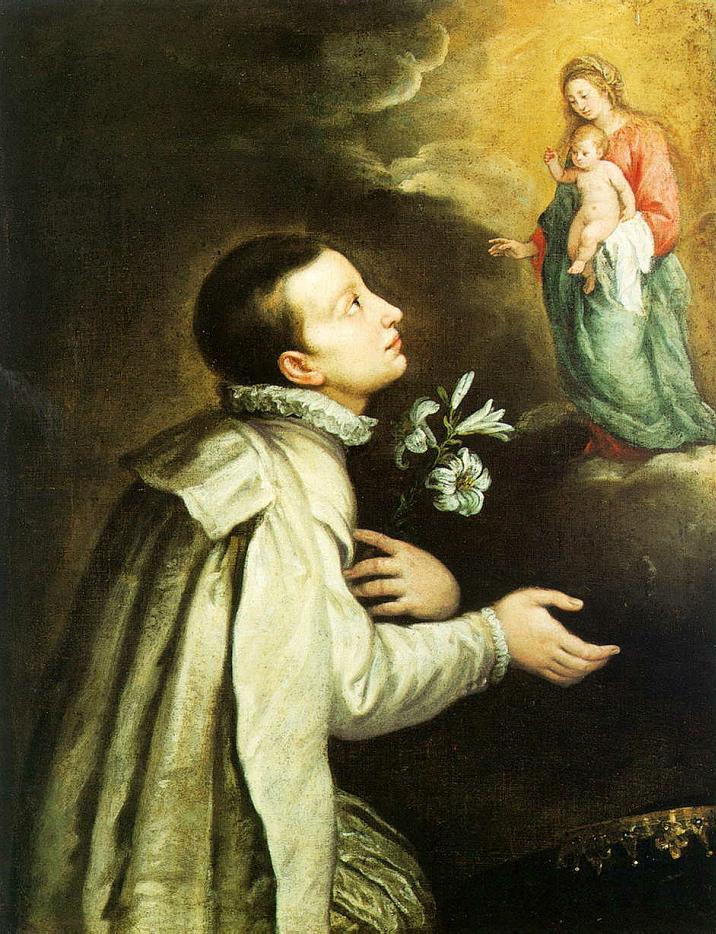
St Aloysius Gonzaga

21 June is the memorial of St Aloysius Gonzaga. The breviary note about him says:

Born in the year 1568 near Mantua in Lombardy, of the noble family of Castiglione. He was brought up piously by his mother and had a vocation to the religious life. He resigned his birthright to his brother and at Rome entered the Society of Jesus. While working among the sick in a hospital he was stricken by the plague and died in the year 1591.

Wednesday, May 26, 2010

St Philip Neri

26 May is the memorial of St Philip Neri.

The breviary says about him:
Born in Florence in the year 1515. He came to Rome and began to devote himself to work among the young men, while at the same time he led a Christian life and formed a brotherhood to look after the sick poor. In 1551 he became a priest and formed the Oratory in which he held services consisting of spiritual readings and hymns, as well as performing charitable works. He was outstanding for love of his neighbour, and evangelical simplicity and joyfulness in the service of God. He died in the year 1595.
More at his Catholic Encyclopedia entry here and his Wiki here.

Tuesday, March 23, 2010

St Turibius of Mongrovejo

23 March is the feast day of St Turibius, Bishop of Lima. The breviary says:

Born in Spain about the year 1538. He studied law in Salamanca and in 1580 was chosen to be Bishop of Lima and went to America. He was on fire with apostolic zeal and called together synods and councils for the purpose of reforming religion in the whole country. He strenuously defended the rights of the Church and looked after the flock committed to his care by going among them on visitation, as well as spending much time and labour for the good of the native Indian population. He died in 1606.

St Turibius was beatified in 1679 by Pope Blessed Innocent XI.

Friday, March 19, 2010

St Joseph, foster-father of our Lord


We don’t really know much about St Joseph because the Gospels don’t tell us much of the life of Jesus after childhood and before the beginning of his public ministry. We do know that his home town was Bethlehem but by the time of the Annunciation he was living in Nazareth.

We know too that because of the census decreed by Caesar Augustus, St Joseph took his pregnant wife, the Blessed Virgin Mary, to Bethlehem where the Saviour was born and laid in a manger. St Matthew (2:13) tells us that an angel appeared to St Joseph warning him to flee with his family to Egypt which he did in time to avoid Herod’s murder of the Holy Innocents in Bethlehem and surrounding area.

It is clear that after some years in Egypt, the Holy Family travelled back to Nazareth and we can surmise that Jesus was taught the craft of St Joseph the Carpenter. The only other significant mention of St Joseph in the Gospels is the "loss" of Jesus in the temple in Jerusalem when Jesus was 12 years old.

We know nothing of the death of St Joseph but it is safe to assume that he died before Christ began his public life; else it’s inevitable he would have been mentioned again in the Gospels. It’s quite probable he died and was buried in Nazareth.

Thursday, March 18, 2010

St Cyril of Jerusalem

Today is the memorial of St Cyril of Jerusalem, Bishop and Doctor of the Church.


The breviary note says about him:
Born of Christian parents in the year 315. He succeeded Maximus as Bishop of Jerusalem in 348. He was involved in the Arian controversy and more than once was sentenced to exile. His Catecheses in which he explained the true doctrine of the faith and Sacred Scripture as well as the tradition of the Church for the sake of the people show his pastoral zeal. He died in the year 386.

His Catholic Encyclopedia entry is here.